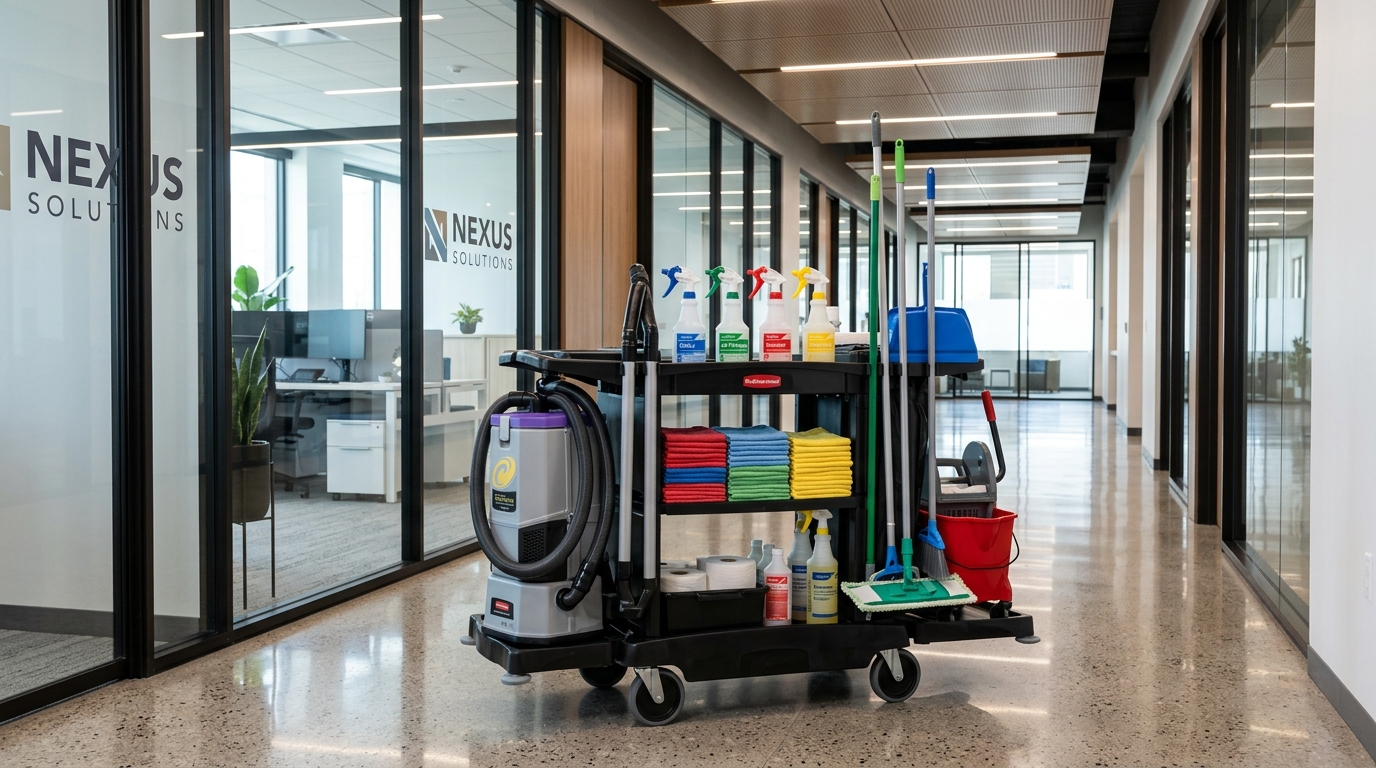
In modern commercial office buildings, substandard cleaning does not just cause aesthetic complaints—it directly impacts corporate absenteeism, employee productivity, and facility lease compliance. Without a rigorous, measurable janitorial scope and cross-contamination engineering, custodial staff inadvertently transfer restroom enteric pathogens directly onto conference tables, keyboards, and lunchroom counters.
Commercial Janitorial Key Takeaways
- ISSA 4-Color Microfiber Coding: Never allow restroom cleaning cloths to cross into common workspaces or breakrooms. Red = Toilets; Yellow = Restroom Sinks; Green = Kitchens; Blue = Desks/Glass.
- Square-Foot Production Benchmarks: Open-plan office spaces require 2,500 to 4,000 sq ft per labor hour. Densely furnished or medical suites require 1,200 to 1,800 sq ft/hr.
- Eliminate 'Clean As Needed' Language: Specify explicit operational frequencies (daily, weekly, monthly) tied to measurable inspection standards.
- CRI-Certified Backpack HEPA Filtration: Commercial backpack vacuums with four-stage HEPA filtration improve indoor air quality and increase worker speed by 230% over upright vacuums.
1. The 4-Color Microfiber Isolation Standard
Cross-contamination occurs when cleaning rags are reused across different rooms. The International Sanitary Supply Association (ISSA) 4-color standard establishes absolute physical separation:
| Color Code | Designated Operational Zone | Specific Target Surfaces & Fixtures |
|---|---|---|
| 🔴 RED | High-Hazard Restroom Bio-Zones | Toilet bowls, urinals, sanitary disposal boxes, toilet flush levers, and adjacent restroom flooring. |
| 🟡 YELLOW | Low-Hazard Restroom Surfaces | Restroom sinks, vanity mirrors, soap dispensers, paper towel dispensers, door push plates, and partitions. |
| 🟢 GREEN | Breakrooms & Food Preparation | Lunchroom tables, refrigerator handles, microwave interiors, cafeteria seating, kitchen counters, and sinks. |
| 🔵 BLUE | General Office & Conference Suites | Workstation desktops, computer monitors, conference table glass, filing cabinets, window ledges, and reception desk. |
2. Square-Foot Production Rates & Labor Estimating
Commercial cleaning costs are governed strictly by labor hours. Bidding too few hours guarantees corner-cutting, while over-estimating inflates operational overhead. Production benchmarks published by the ISSA define standard times per 1,000 square feet:
- Standard Open Office (2,500 – 4,000 sq ft/hr): Wide open carpeted floorplates with uniform modular cubicles, low fixture density, and centralized trash collection stations.
- Executive / Partitioned Law Office (1,800 – 2,500 sq ft/hr): Heavy hardwood furnishings, numerous private enclosed offices with individual trash cans, and extensive glass conference walls.
- Medical & Life Sciences (1,200 – 1,600 sq ft/hr): Clinical exam rooms, high-frequency terminal disinfectant dwell times, and bio-waste sharps container management.
3. Standard Commercial Scope Frequency Matrix
An airtight janitorial scope separates services into strict calendar cadences:
| Service Cadence | Scope Tasks Included | Quality Standard |
|---|---|---|
| Daily (Nightly Service) | Empty all trash & recycling; replace liners; clean and disinfect restrooms; restock paper goods & hand soap; wipe breakroom tables and counters; spot-vacuum carpet traffic lanes; damp-mop hard surface lobby floors; disinfect exterior entrance door touchpoints. | Zero visible trash; restrooms sanitized to <100 RLU ATP swab; paper dispensers 100% full. |
| Weekly | Full wall-to-wall HEPA vacuuming including under desks and edge-crevices; detailed damp-wiping of conference room credenzas and chairs; low-dusting baseboards and horizontal chair rails; spot-clean interior partition glass. | Zero dust bunnies behind desks; glass free of smudges and fingerprints. |
| Monthly | High-dusting overhead HVAC diffusers, ceiling vents, and door frames (above 7 feet); detail scrub ceramic restroom tile grout; wipe all office chair casters and trash bin interiors. | Zero dust accumulation on vents; no blackened tile grout lines. |
| Quarterly / Annual | Commercial carpet hot-water extraction; hard floor stripping, sealing, and high-speed burnishing; exterior and interior perimeter window washing. | Carpet pile revived; VCT floor high-gloss reflection restored. |
4. Vetting Commercial Cleaning Contracts & RFPs
When drafting a Request for Proposal (RFP) for commercial janitorial services, ensure the following clauses are incorporated:
- Mandate W-2 Custodial Staff: Insist on W-2 directly employed cleaners rather than unvetted 1099 sub-contractors. This ensures the contractor carries direct Workers' Compensation coverage and conducts federal background checks.
- Require COI with $2,000,000 Aggregate: Request a Certificate of Insurance (COI) naming the property owner as an Additional Insured with a minimum $1M/$2M commercial general liability limit.
- Deficiency Remedy Window: Include a service level agreement (SLA) clause requiring reported cleaning deficiencies to be rectified within 12 hours at no additional charge.
Related Commercial Tools & Scope Templates
Download our commercial office janitorial scope template table or estimate square footage commercial rates across Tier 1, 2, and rural markets.
This technical document serves as a permanent site chain-of-custody and clearance record. Retain in property remediation compliance file for minimum 3 years per 29 CFR 1910.1030(h).