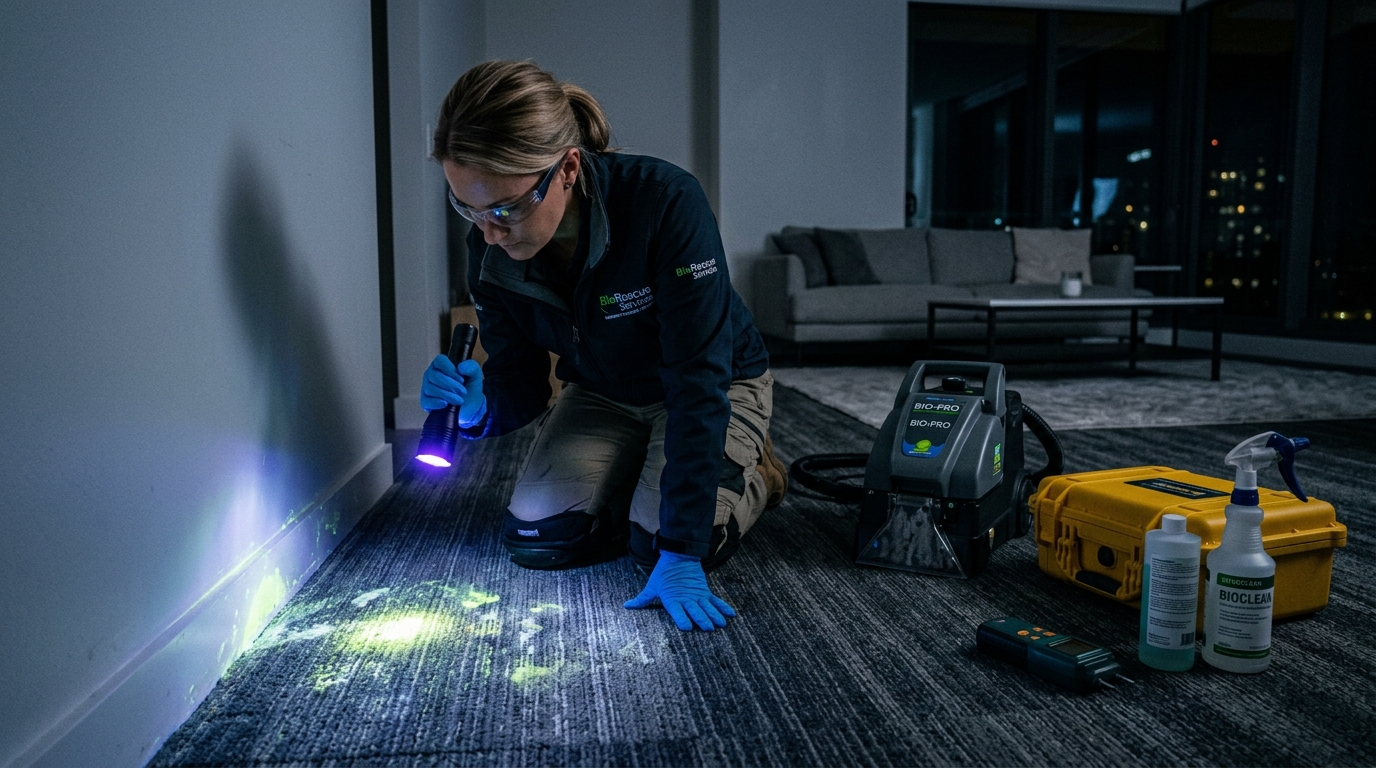
Supermarket carpet shampoos, vinegar sprays, and baking soda remedies fail on pet urine for a basic biochemical reason: they only treat water-soluble urea and urochrome pigments. They leave behind microscopic uric acid salt crystals. Whenever atmospheric humidity exceeds 60%, these crystals absorb moisture, releasing volatile mercaptan gases that human noses detect as pungent, stale ammonia.
Key Pet Urine Remediation Takeaways
- Never Use Heat or Steam: High temperatures cook and bind animal proteins into synthetic carpet fibers, rendering stains and odors permanent.
- UV 395nm Inspection: The surface stain is always smaller than the contamination in the padding; urine spreads downward in an inverted cone shape.
- Dwell Time is Mandatory: Bio-enzymatic digesters require a minimum of 4 to 8 hours of active moisture beneath plastic wrap to consume uric crystals.
- Shellac Subfloor Sealing: When padding is soaked, standard latex paint will not block odor. Only 100% shellac-based primer permanently seals urine odors in wooden subfloors.
1. The Biochemistry of Pet Urine Breakdown
Understanding the chemical stages of pet urine explains why traditional cleaning methods backfire:
- Stage 1 (Acidic Fresh Urine, pH 5–6): Fresh urine is a warm, acidic liquid that acts as an ideal breeding ground for bacteria.
- Stage 2 (Alkaline Salt Formation, pH 9–10): Within hours, bacteria consume the urea, off-gassing ammonia. The liquid dries into insoluble, alkaline uric acid salts that bond tenaciously to carpet backing.
- Stage 3 (Re-activation via Humidity): Standard cleaners dissolve the urea smell temporarily. But the uric acid crystals remain dormant until a humid summer day, rainstorm, or hot carpet cleaning reactivates them.
2. Forensic Inspection: UV Blacklight & Moisture Mapping
Never guess where urine spots are located. Technicians use precision diagnostic tools:
- 395nm UV Inspection: In total darkness, phosphorus and protein components fluoresce with a dull green/yellow glow under 395nm wavelength light.
- Pin Moisture Meter Mapping: Because dried urine crystals are hygroscopic salts, they maintain higher electrical conductivity than dry carpet. A pin-type moisture meter will register elevated readings on active deposits.
- Perimeter Chalking: Mark a circle 6 inches wider than the visible fluorescent zone to account for the inverted cone spread in the underlying padding.
3. Step-by-Step Bio-Enzymatic Remediation Protocol
4. Severe Cases: Subfloor Replacement & Shellac Sealing
If urine has penetrated the subfloor repeatedly for months, cleaning the carpet face is insufficient. Technicians must perform structural encapsulation:
- Peel back carpet from the tack strip and slice out contaminated foam padding (padding cannot be salvaged and must be discarded).
- Scrub the exposed plywood, OSB, or concrete subfloor with a 12% hydrogen peroxide solution to oxidize organic stains.
- Apply two heavy coats of 100% white shellac-based primer (e.g. Zinsser B-I-N). Shellac creates an impermeable alcohol-based barrier that permanently traps odor molecules, unlike water-based latex primers that re-dissolve when exposed to moisture.
- Install fresh virgin foam padding, reinstall the carpet, and perform a power-stretch.
Need Pricing or Professional Vetting for Pet Odor?
Check 2026 sub-surface enzymatic extraction costs or read our cleaner vetting guide to verify insurance coverage.
This technical document serves as a permanent site chain-of-custody and clearance record. Retain in property remediation compliance file for minimum 3 years per 29 CFR 1910.1030(h).