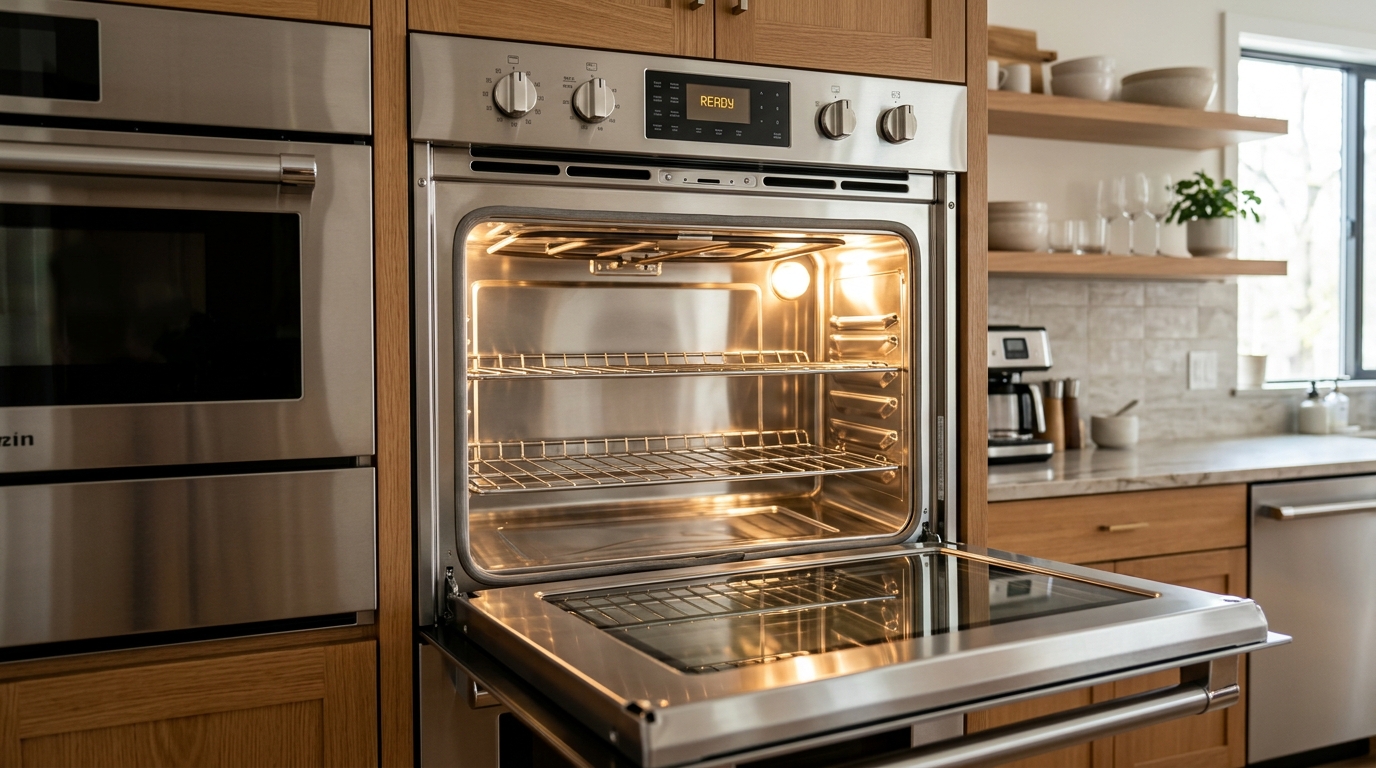
In professional residential turnover and move-out inspections, the oven and range hood account for over 40% of all landlord deposit disputes. Baked-on grease undergoes a chemical process known as thermal polymerization: cooking oils repeatedly exposed to heat cross-link into a resilient, lacquer-like plastic that resists standard household all-purpose sprays.
Appliance Degreasing Key Takeaways
- Avoid the High-Heat Self-Cleaning Cycle: Heating ovens to 900°F releases toxic fluoropolymer vapors (fatal to pet birds) and commonly burns out internal thermal limit switches.
- Understand Saponification: Polymerized cooking fats are esters that must be broken down by alkaline solutions (pH 10–11) like sodium carbonate (washing soda), converting oil into water-soluble soap.
- Never Scratch Porcelain Enamel: Avoid wire brushes, steel wool, or razor blades on porcelain cavity walls; scratches expose bare sheet steel to rapid rusting.
- Boiling Percarbonate for Filters: Submerging range hood grease filters in boiling water with sodium percarbonate dissolves 100% of trapped grease within 15 minutes without scrubbing.
1. The Chemistry of Burnt Carbon & Polymerized Grease
Understanding what is inside your oven is critical to selecting the right chemical reagent:
- Polymerized Fats (Amber/Brown Coating): Triglyceride oils that have oxidized and bonded to the porcelain enamel. These are acidic organic compounds that react rapidly with high-pH alkaline saponifiers.
- Pyrolyzed Carbon (Black Crust): Food sugars and proteins that have completely carbonized under 400°F+ baking temperatures. Carbon cannot be dissolved by acids; it requires sustained chemical softening (moist dwell time) and non-abrasive mechanical lifting.
2. Step-by-Step Cavity Degreasing Protocol
Follow this safe, non-toxic chemical sequence to restore severely soiled ovens without caustic aerosol fumes:
| Phase | Target Surface | Formulation & Action |
|---|---|---|
| Phase 1: Soak | Wire Racks & Drip Pans | Bathtub soak: Hot water + 1 cup washing soda + 1/4 cup dish soap. Soak for 3 hours; wipe with non-scratch scrub pad. |
| Phase 2: Paste | Enamel Cavity & Floor | Alkaline paste (baking soda + washing soda + dish soap). Apply generously; cover heavy burnt spots with plastic wrap. Dwell 4 to 8 hours. |
| Phase 3: Release | Oven Door Glass | Apply paste to glass; scrape softened crust using a plastic putty knife held at a 30-degree angle. Never use steel razor blades on dry glass. |
| Phase 4: Neutralize | Whole Interior | Mist with 50% distilled white vinegar solution. The mild acid neutralizes remaining alkaline film, creating an easy-to-wipe water solution. |
3. Range Hood Baffle & Mesh Filter Restoration
Range hood filters trap aerosolized grease from frying and cooking. When saturated, grease drips back onto stove burners, presenting an active fire hazard.
- Identify Filter Material: Commercial baffle filters are typically stainless steel; residential filters are multi-layer expanded aluminum mesh.
- The Boiling Sodium Percarbonate Method: Place filters in a heat-resistant sink or deep roasting pan. Sprinkle 1/2 cup of sodium percarbonate (oxygen bleach powder) over the filters. Pour boiling water directly over them.
- Effervescent Degreasing: The hot solution releases millions of micro-bubbles of pure oxygen combined with sodium carbonate, lifting grease out of the internal mesh layers in under 15 minutes.
- Rinse & Dry: Flush with scalding tap water and let air dry completely before reinserting into the ventilation hood.
4. Cleaning Between the Double Glass Door Panes
Spills and condensation frequently run through top ventilation slots, leaving amber drip marks between the inner and outer glass panels:
- Unscrew Top Retaining Bracket: Open the oven door to a 45-degree angle. Locate the 2 to 4 screws along the top metal trim. Remove them carefully.
- Slide Out Center Pane: Gently lift the retaining bracket and slide the glass panel upward. Place it flat on a padded bath towel.
- Clean with Alcohol/Vinegar: Clean both interior faces with 70% isopropyl alcohol or white vinegar using a lint-free microfiber cloth. Ensure 100% dry before reassembly to prevent trapped fog.
Related Kitchen Turnover & Cleaning Guides
Explore our complete move-out deposit recovery protocol or estimate professional deep cleaning costs for your home.
This technical document serves as a permanent site chain-of-custody and clearance record. Retain in property remediation compliance file for minimum 3 years per 29 CFR 1910.1030(h).